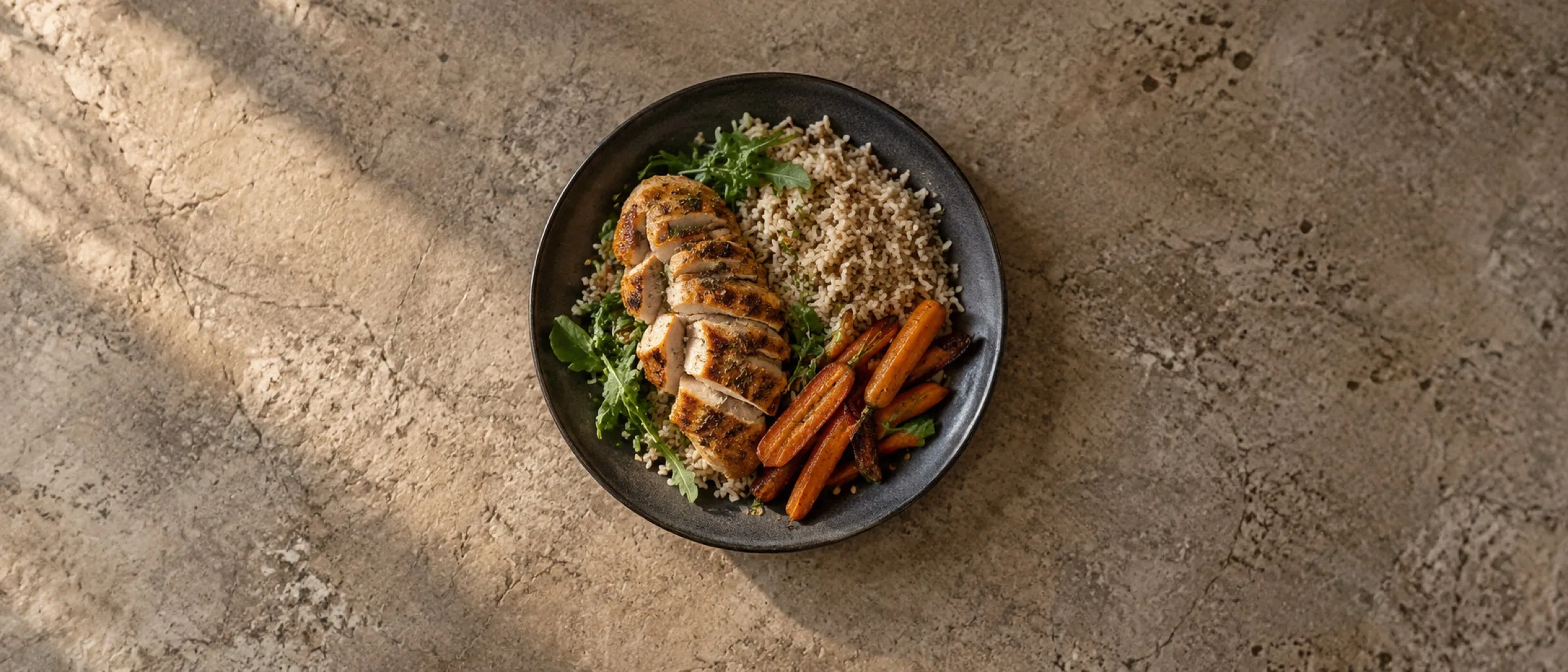
A cut means eating a little less than you burn while you keep training hard, so you lose fat and keep the muscle you’ve built. In practice, lose about 0.5 to 1% of your body weight a week, eat about 0.9 to 1.5 g of protein per pound of body weight (1.9 to 3.2 g per kilogram), and keep lifting the way you did when you built the muscle. The rate comes from a 2014 review of contest prep for natural bodybuilders by Eric Helms, Alan Aragon and Peter Fitschen. The protein range comes from the International Society of Sports Nutrition’s 2026 position stand.
It’s the other half of a lean bulk. The bulk adds muscle with a little fat. The cut takes the fat back off.
A cut at a glance
| Part of the cut | What to aim for |
|---|---|
| Rate | 0.5 to 1% of body weight a week |
| Deficit | About 450 to 900 calories a day for a 180 lb lifter |
| Protein | 0.9 to 1.5 g per pound (1.9 to 3.2 g per kilogram) |
| Fat | 15 to 30% of calories |
| Carbs | The rest, eaten around your training |
| Training | Keep lifting heavy. Cardio is fine |
| Sleep | Protect it. Short nights cost fat loss and muscle |
| Length | About two to four months, then a break at maintenance |
What is a cut?
When you eat less than you burn, your body makes up the gap from what it has stored. Some of that comes from fat, and some can come from muscle. A cut tries to tilt it toward fat.
Three things do most of the tilting. You keep the deficit moderate, you eat enough protein, and you keep lifting, so your body has a reason to hold on to its muscle. Get those right and most of what you lose is fat. Get them wrong, and you can end a cut lighter but softer.
Cutting vs bulking: which should you do first?
Cut if you’re carrying more fat than you’d like. Bulk if you’re fairly lean and want more size. If you’re somewhere in between, or new to lifting, eating around maintenance with plenty of protein can do some of both for a while. The lean bulk post covers how to choose between bulking, cutting and recomp.
Many lifters alternate. They bulk for several months, then cut for a couple, and the macro calculator sets targets for either.
How many calories to cut?
Start with your maintenance calories, the amount you burn in a typical day. The TDEE calculator gives you a first estimate. Then eat below it.
How far below depends on how fast you want to lose. A pound of body fat holds about 3,500 calories, so each pound a week takes a deficit of about 500 calories a day. For a 180 lb (82 kg) lifter, it works out like this.
| Rate | Loss a week | Deficit a day |
|---|---|---|
| 0.5% of body weight | 0.9 lb | about 450 |
| 0.75% of body weight | 1.35 lb | about 675 |
| 1% of body weight | 1.8 lb | about 900 |
Which row should you pick? If you want to keep building muscle while you cut, stay near the first one. In a 2022 meta-analysis, people who lifted in a calorie deficit still got stronger, but they built less muscle, and a deficit of about 500 calories a day was enough to stop muscle gains. The authors advised lifters who want to keep their muscle to stay under that. The last row, 1% a week, is a ceiling, not a goal.
How fast to lose weight on a cut
About 0.5 to 1% of your body weight a week is the usual guidance, and the slower end protects muscle better. The 2026 position stand from the International Society of Sports Nutrition gives the same range. Most of that advice rests on expert reviews, though, and on one small trial.
In that 2011 trial, 24 elite athletes lost about 5.5% of their body weight, either slowly or quickly, while they lifted four times a week. The slow group lost about 0.7% a week and took eight and a half weeks. Their lean mass went up by 2.1%. The fast group lost about 1% a week and took five weeks. Their lean mass didn’t change. Neither group lost muscle, but only the slow group gained it.
The leaner you are, the more slowly you should go. As Gilbert Forbes showed, the less fat you carry, the larger the share of any weight you lose that comes from lean tissue. Training and protein shift that a long way in your favor. In a 2017 study of athletes who lost weight over a season, 90% of the energy came from fat.
Protein on a cut
Protein matters more on a cut than on a bulk. Aim for about 0.9 to 1.5 g per pound of body weight, or 1.9 to 3.2 g per kilogram. That’s the range the ISSN’s 2026 stand gives for lean lifters in a deficit. Go higher the leaner you are and the bigger your deficit, as a systematic review of lean, trained lifters found. If you’re carrying more fat, the lower end is plenty.
It can make a real difference. In a 2016 trial, 40 young men ate 40% less than they burned for four weeks while they trained six days a week. The ones eating 2.4 g of protein per kilogram gained 1.2 kg of lean mass and lost 4.8 kg of fat. The ones eating 1.2 g gained 0.1 kg of lean mass and lost 3.5 kg of fat. Same calories, different results.
The rest of your calories split between carbs and fat. Helms and colleagues suggest keeping fat at 15 to 30% of your calories, partly because very low-fat diets may lower testosterone. Carbs fill the rest, and they fuel your training. The macro calculator does this split for your own numbers.
What to eat on a cut
There’s no special cutting diet. It’s your normal diet with less of the dense stuff, built around protein.
- Hit your protein every day. It’s the one number that matters most. Spread it over three to five meals, so each one has a real serving.
- Eat for volume. Vegetables, fruit, potatoes and lean meat and fish are big for their calories. Oil, nut butter, cheese and drinks are small for theirs.
- Keep your carbs around training. You’ll lift better with some carbs before and after.
- Pick the split you can stick with. The ISSN’s 2026 stand says the balance of carbs and fat can follow “personal preference”. Low-carb and low-fat both work when the calories match.
- Log the small things. The oil in the pan, the sauce, the drink and the bites while you cook are often the whole deficit. On a cut, you can’t eyeball them.
A sample cutting day
Here’s what about 2,170 calories looks like for our 180 lb lifter, in ordinary food. If their maintenance is 2,700, as in the lean bulk example, that’s about 530 calories under it, or about 1 lb a week. The numbers come from USDA FoodData Central.
| Meal | Food | Calories | Protein |
|---|---|---|---|
| Breakfast | 300 g plain low-fat Greek yogurt, 40 g oats, 1 cup blueberries, 1 tbsp honey | 520 | 36 g |
| Lunch | 6 oz roast chicken breast, 1 cup cooked white rice, 2 cups cooked broccoli, 1 tsp olive oil | 580 | 61 g |
| Before training | 1 slice whole-wheat toast, 1 tbsp peanut butter, 1 medium banana | 280 | 9 g |
| Dinner | 6 oz salmon, 1 medium baked potato with the skin, 1 cup green beans | 560 | 44 g |
| Evening | 1 cup 2% cottage cheese, 1 cup strawberries | 230 | 25 g |
| Total | 2,170 | 175 g |
That’s 175 g of protein, 57 g of fat and about 245 g of carbs. Protein is about 1 g per pound, fat is 24% of calories, and the carbs sit around training. Swap any food for one you like with similar numbers. It’s an example, not a plan. Log what you actually eat.
Training on a cut
Keep lifting the way you did when you built the muscle. Heavy, hard sets tell your body the muscle is still needed. If you stop, or switch to light weights for “toning”, you give it a reason to let go.
You don’t need more volume than usual. In a 2023 trial of 38 trained men in a deficit, five sets per exercise kept no more lean mass than three. Expect your strength to hold or dip a little, and don’t chase new personal records every week.
Cardio is fine. A 2022 meta-analysis of 43 studies found that adding cardio to strength training didn’t reduce muscle growth or maximal strength. It did blunt explosive strength a little, mostly when both were done in the same session. So if you care about jumping or sprinting, do your cardio on another day or at another time.
Sleep on a cut
Sleep is the easiest part of a cut to skip, and it may cost you muscle. In a 2010 study, 10 adults dieted for two weeks twice, once with 8.5 hours in bed and once with 5.5. With less sleep, they lost 55% less fat and 60% more fat-free mass. It was a small study, and fat-free mass includes water, but a 2018 trial found the same pattern from losing about an hour of sleep five nights a week.
Managing hunger
You will get hungry. That’s normal, and it gets stronger as the cut goes on. A few things help.
- Protein. Besides keeping muscle, it fills you up a little more than carbs or fat.
- Fiber and volume. In the POUNDS Lost trial, fiber was the strongest predictor of who stuck to their diet and lost weight. In a year-long trial, women who added fruit and vegetables to a lower-fat diet lost more weight and said they were less hungry.
- Breaks, if you need them. In a 2021 trial of 61 lifters, taking a week at maintenance after every three weeks of dieting didn’t change fat loss or muscle, but people were less hungry. The weight loss plateau post covers breaks in more detail.
How long should a cut last?
There’s no trial that answers this. It’s expert opinion. Helms and colleagues suggest that cuts of two to four months, at 0.5 to 1% a week, keep muscle better than shorter, harder ones, and that leaner people should cut for shorter stretches. The ISSN’s 2026 stand notes that progress tends to slow after 8 to 12 weeks.
A practical rule is to cut until you reach the leanness you wanted, or until the cut has run two or three months, whichever comes first. Then spend a few weeks at maintenance before you decide what’s next.
What about a mini cut?
A mini cut is a short, hard cut of two to six weeks, usually in the middle of a bulk. You’ll see it everywhere, but there’s no research on mini cuts by that name.
The closest evidence comes from short, aggressive diets in athletes. In a 2010 study, 20 trained athletes ate 60% of their usual calories for two weeks. Those eating about 1 g of protein per kilogram lost 1.6 kg of lean mass, and those eating 2.3 g lost 0.3 kg. So if you try one, keep it short and keep protein high.
Track the trend, then adjust
Weigh yourself every morning, and look at the trend rather than any one day. The first week of a cut often shows a big drop, and much of it is water from the glycogen you burn through, not fat. After that, the trend settles.
Then compare your trend with your target rate every couple of weeks.
- Losing too slowly? Take off another 100 to 200 calories a day, or add some walking.
- Losing too fast? Add about the same back, especially if your lifts are dropping.
- On target, and your lifts are holding? Leave it alone.
Expect the scale to slow as the cut goes on. A smaller body burns less, and hunger pushes you to eat more. If the trend stops for weeks, that’s a plateau, and it has its own fixes.
Cutting in Fit Shapes
Choose Lose weight as your goal and set a weekly rate from the table above. Fit Shapes suggests 0.5 to 1.5 lb a week, and the screen shows about how many calories a day that gives you. Set Protein to High or Extra High.
Then log your food and weigh in. Every Monday, the check-in compares what you ate with how your trend weight moved, works out what you actually burned, and proposes new targets for the rate you chose. As you get lighter and burn less, those targets come down with you, at most 250 calories a day at a time. How Adaptive Targets work explains the math.
Sources
18 sources
- Helms ER, Aragon AA, Fitschen PJ. Evidence-based recommendations for natural bodybuilding contest preparation: nutrition and supplementation. J Int Soc Sports Nutr. 2014;11:20. pmc.ncbi.nlm.nih.gov/articles/PMC4033492/
- Aragon AA, Campbell BI, Schoenfeld BJ, Stout JR, Kalman D, Arciero PJ, et al. International Society of Sports Nutrition position stand: diets for body weight reduction. J Int Soc Sports Nutr. 2026;23(1):2740266. pmc.ncbi.nlm.nih.gov/articles/PMC13665703/
- Garthe I, Raastad T, Refsnes PE, Koivisto A, Sundgot-Borgen J. Effect of two different weight-loss rates on body composition and strength and power-related performance in elite athletes. Int J Sport Nutr Exerc Metab. 2011;21(2):97–104. pubmed.ncbi.nlm.nih.gov/21558571/
- Forbes GB. Body fat content influences the body composition response to nutrition and exercise. Ann N Y Acad Sci. 2000;904:359–365. pubmed.ncbi.nlm.nih.gov/10865771/
- Silva AM, Matias CN, Santos DA, Rocha PM, Minderico CS, Thomas D, et al. Do dynamic fat and fat-free mass changes follow theoretical driven rules in athletes? Med Sci Sports Exerc. 2017;49(10):2086–2092. pubmed.ncbi.nlm.nih.gov/28542004/
- Helms ER, Zinn C, Rowlands DS, Brown SR. A systematic review of dietary protein during caloric restriction in resistance trained lean athletes: a case for higher intakes. Int J Sport Nutr Exerc Metab. 2014;24(2):127–138. pubmed.ncbi.nlm.nih.gov/24092765/
- Longland TM, Oikawa SY, Mitchell CJ, Devries MC, Phillips SM. Higher compared with lower dietary protein during an energy deficit combined with intense exercise promotes greater lean mass gain and fat mass loss: a randomized trial. Am J Clin Nutr. 2016;103(3):738–746. pubmed.ncbi.nlm.nih.gov/26817506/
- Murphy C, Koehler K. Energy deficiency impairs resistance training gains in lean mass but not strength: a meta-analysis and meta-regression. Scand J Med Sci Sports. 2022;32(1):125–137. doi.org/10.1111/sms.14075
- Roth C, Schwiete C, Happ K, Rettenmaier L, Schoenfeld BJ, Behringer M. Resistance training volume does not influence lean mass preservation during energy restriction in trained males. Scand J Med Sci Sports. 2023;33(1):20–35. pubmed.ncbi.nlm.nih.gov/36114738/
- Schumann M, Feuerbacher JF, Sünkeler M, Freitag N, Rønnestad BR, Doma K, et al. Compatibility of concurrent aerobic and strength training for skeletal muscle size and function: an updated systematic review and meta-analysis. Sports Med. 2022;52(3):601–612. pmc.ncbi.nlm.nih.gov/articles/PMC8891239/
- Nedeltcheva AV, Kilkus JM, Imperial J, Schoeller DA, Penev PD. Insufficient sleep undermines dietary efforts to reduce adiposity. Ann Intern Med. 2010;153(7):435–441. pmc.ncbi.nlm.nih.gov/articles/PMC2951287/
- Wang X, Sparks JR, Bowyer KP, Youngstedt SD. Influence of sleep restriction on weight loss outcomes associated with caloric restriction. Sleep. 2018;41(5):zsy027. pmc.ncbi.nlm.nih.gov/articles/PMC8591680/
- Miketinas DC, Bray GA, Beyl RA, Ryan DH, Sacks FM, Champagne CM. Fiber intake predicts weight loss and dietary adherence in adults consuming calorie-restricted diets: the POUNDS Lost (Preventing Overweight Using Novel Dietary Strategies) study. J Nutr. 2019;149(10):1742–1748. pmc.ncbi.nlm.nih.gov/articles/PMC6768815/
- Ello-Martin JA, Roe LS, Ledikwe JH, Beach AM, Rolls BJ. Dietary energy density in the treatment of obesity: a year-long trial comparing 2 weight-loss diets. Am J Clin Nutr. 2007;85(6):1465–1477. pmc.ncbi.nlm.nih.gov/articles/PMC2018610/
- Peos JJ, Helms ER, Fournier PA, Ong J, Hall C, Krieger J, et al. Continuous versus intermittent dieting for fat loss and fat-free mass retention in resistance-trained adults: the ICECAP trial. Med Sci Sports Exerc. 2021;53(8):1685–1698. doi.org/10.1249/MSS.0000000000002636
- Mettler S, Mitchell N, Tipton KD. Increased protein intake reduces lean body mass loss during weight loss in athletes. Med Sci Sports Exerc. 2010;42(2):326–337. pubmed.ncbi.nlm.nih.gov/19927027/
- Wishnofsky M. Caloric equivalents of gained or lost weight. Am J Clin Nutr. 1958;6(5):542–546. doi.org/10.1093/ajcn/6.5.542
- U.S. Department of Agriculture, Agricultural Research Service. FoodData Central, SR Legacy. Accessed 2026-10-16. fdc.nal.usda.gov/